
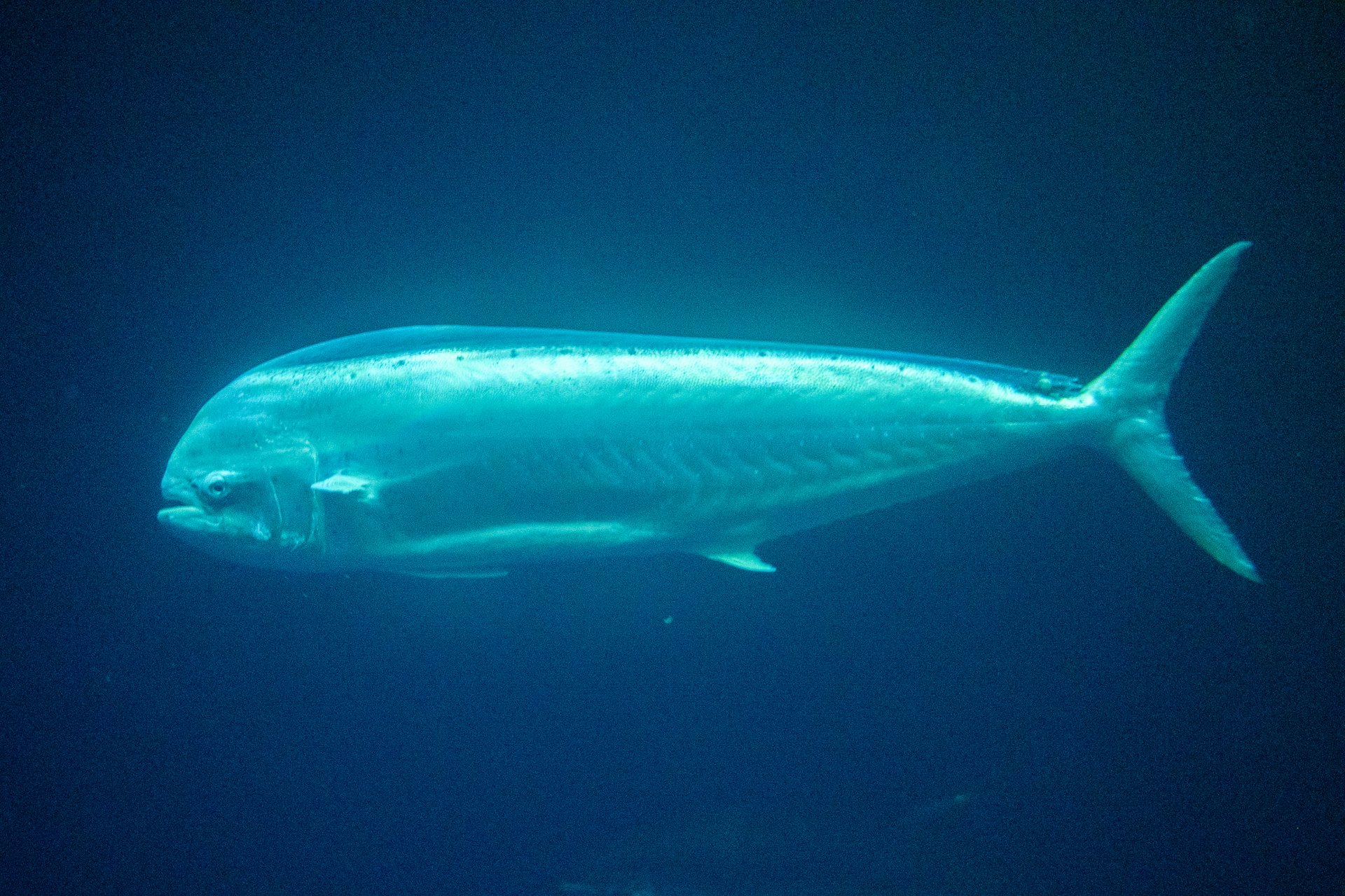
If we had to pick one fish to introduce a newcomer to offshore fishing, it would be the mahi-mahi. Coryphaena hippurus, called dorado in Latin America and dolphinfish along much of the Atlantic coast, is fast, abundant, spectacular in color and superb on the plate. It also has one of the most remarkable life histories in the ocean. This guide covers the biology that makes mahi so productive, where to find them along weed lines and under birds, how we troll and pitch baits for them, and the etiquette of keeping a school at the boat.
A fish built for speed and growth
Mahi are unmistakable. The body is compressed and tapers from a blunt head to a deeply forked tail, with a single dorsal fin that runs almost the full length of the back. Colors shift in seconds between electric blue, green and gold, flecked with blue spots, and they fade to a dull gray within minutes of death, which is why photos of a fish on ice never do it justice. Males, called bulls, develop a tall, square forehead as they mature; females, or cows, keep a rounded profile. The pompano dolphin, Coryphaena equiselis, is a smaller, deeper-bodied look-alike.
What sets this species apart is its growth. A mahi hatches from an egg smaller than a pinhead and can weigh 10 pounds by the end of its first year and 30 pounds or more in its second. Scientists have measured daily growth rates of more than a quarter inch in juveniles. Sexual maturity arrives at four to six months of age, and a mature female may spawn every few days through the warm season, releasing hundreds of thousands of eggs each time. The price of all that speed is a short life. Most mahi live two to three years, and a fish of four or five years is an old one. Even the big bulls of 50 to 70 pounds are rarely older than that.
Where they hold: weed lines, debris and birds
Mahi are creatures of the surface layer, most comfortable in water above 70 degrees Fahrenheit and often in the high 70s and 80s. They orient to anything that floats. A well-formed sargassum weed line along a current edge is the classic target, because the weed shelters juvenile fish, crabs and shrimp that mahi feed on. A single pallet, a tree trunk or a lost buoy in open water can hold a school of a hundred fish. In the Gulf of Mexico and the Florida Straits, the Gulf Stream and Loop Current edges concentrate weed into long lines that can run for miles.
Birds are the second sign. Frigatebirds circling high and slow are following predators pushing bait, and mahi are often under them. Terns dipping to the surface mark small bait being driven up. Offshore, we watch the horizon for birds more than the sounder, because mahi rarely show on a screen. Prime months in the Keys and South Florida run April through June with a second push in fall; the northern Gulf fishes best from May through September; the mid-Atlantic canyons peak from July into October; and Central American and Caribbean waters produce fish for most of the year.
Trolling ballyhoo and covering water
The most reliable way to find mahi is to troll along the weed line or debris at 6 to 8 knots. Rigged ballyhoo, naked or under small skirts in blue and white, pink or green, are hard to beat. We run a mix of flat lines close to the transom and long baits off the outriggers, with a small chain teaser or daisy chain to add flash. Light to medium tackle is all that is needed: 20 to 30 pound class outfits with 40 to 60 pound fluorocarbon leaders and 6/0 to 7/0 hooks. The strike is fast, the first run is fast, and then the fish greyhounds across the surface in one of the best light-tackle fights anywhere.
Once a fish is hooked and the school follows it up, we switch to pitching. Chunks of ballyhoo or squid on a bare hook, small bucktail jigs, or a live pilchard cast at the edge of the school will take fish after fish. A spinning outfit with 20 to 30 pound braid and a 40-pound leader is perfect for this, and the same outfit will throw a popper at a bull that is holding back from the boat.
- Trolling: 20 to 30 pound class, 6 to 8 knots, rigged ballyhoo and small skirted lures
- Pitching: 4000 to 6000 size spinning reel, 20 to 30 pound braid, 40 pound fluorocarbon
- Hooks: 6/0 to 7/0 for baits, 3/0 to 5/0 for chunks; circle hooks reduce deep hooking
- Extras: a chum bucket of cut ballyhoo, a landing gaff and a dedicated fish box with ice
Keeping the school at the boat
Mahi are schooling fish, and a hooked mahi holds its schoolmates. The oldest trick in the game is to leave the first fish in the water, swimming on the line beside the boat, while the rest of the crew casts to the school that gathers around it. Pull that first fish over the gunwale and the school often vanishes. We keep one fish out of the boat until another is hooked, then rotate them. Scattering a few chunks keeps the school interested, but too much chum fills the fish up and they drift off. Work quickly, keep noise down and avoid driving the boat through the school.
Bag limits, ethics and the table
Because mahi grow and reproduce so quickly, the species tolerates fishing pressure better than most, but that is not a license to fill the boat. Recreational bag limits exist in United States waters. Federal rules in the Atlantic have long set a per-person daily limit and a vessel cap, and Florida imposes its own size minimum and reduced per-person limits in state waters. The numbers have been revised more than once in recent years and vary between the Gulf and the Atlantic. Check the current NOAA Fisheries regulations and your state agency before you go, and remember that small fish under a couple of pounds are barely mature and are worth releasing.
The reward for restraint is one of the finest eating fish in the sea. Mahi flesh is firm, mild and slightly sweet, with a large flake that holds together on the grill. Bleed the fish, get it on ice immediately and fillet it the same day. We prefer to grill thick fillets skin-on over high heat with nothing more than oil, salt and lime, though it is equally good blackened, seared or in tacos. Few fish deliver so much, so quickly, and ask so little in return.