
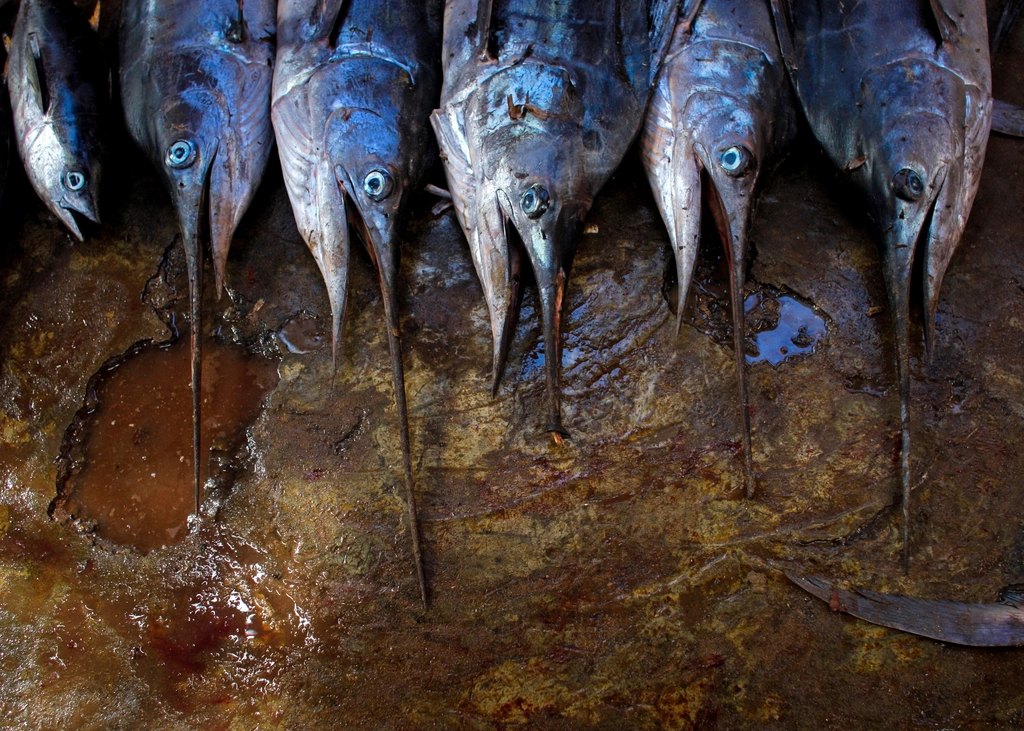
The Atlantic sailfish is the billfish that anglers meet first and remember longest. Istiophorus platypterus is lighter and faster than a marlin, it lives within sight of the beach for much of the year, and it fights in the air as much as in the water. Along the east coast of Florida, the winter run has built an entire style of fishing around kites and live baits, and the fishery is almost entirely catch and release. This guide covers the fish, the season, the mechanics of kite fishing, and how to release a sailfish so it swims off strong.
The fish and its habits
Sailfish are recognizable at a glance by the enormous dorsal fin that runs most of the body length and stands taller than the body is deep. The fin is cobalt blue with dark spots and is raised when the fish is excited, herding bait or lit up beside the boat. The bill is long, round and slender; the body is dark blue above and silver below, often crossed by vertical bars that flash blue when the fish is feeding. Scientists now treat the Atlantic and Indo-Pacific sailfish as one species, though Pacific fish grow considerably larger. Florida sails average 30 to 60 pounds and 6 to 7 feet long; Pacific fish from Central America commonly exceed 100 pounds.
Sailfish grow quickly, maturing in their second or third year, and are believed to live only a handful of years. They hunt in small groups near the surface, using the sail to corral schools of sardines, pilchards, goggle-eyes and ballyhoo, and they feed heavily along color changes and current edges where the Gulf Stream brushes the reef. Their speed is legendary, as anyone who has watched one run off 200 yards of line in seconds can confirm.
The Florida winter run
Sailfish are present off South Florida year-round, but the main event begins when the first strong cold fronts of late fall push bait south along the coast. From November through March, and especially from December through February, fish migrate down the Atlantic side in waves, and the days after a front, with a north wind against the Gulf Stream, are the days when boats post double-digit release counts. Stuart, on the Treasure Coast, has called itself the sailfish capital for generations, and the fishing off Palm Beach, Fort Lauderdale, Miami and the upper Keys is every bit as strong. The fish hold along the reef edge in 90 to 250 feet of water and where the current meets cooler green water inshore.
Spring brings a second, smaller push as the fish move north again, and summer produces scattered fish along the edge. The tournament season on that coast is built around one number: sailfish released per day.
Kites and live goggle-eyes
Kite fishing is the defining technique of the Florida sailfish fleet. A fishing kite is flown from a dedicated rod with a short, heavy line, and one to three release clips are spaced along that line. The fishing lines are clipped so that the live bait dangles at the surface directly below the kite, splashing and struggling with no line or leader in the water for a sailfish to see. When a fish takes the bait, the line pulls free of the clip, the angler winds tight and the circle hook sets itself in the corner of the jaw. Two kites on either side of a drifting boat can present six baits across a wide spread.
Goggle-eyes are the premium bait because they are hardy and swim actively under the kite for hours; threadfin herring, pilchards, cigar minnows and blue runners all work when goggle-eyes are scarce. The bait is bridled through the nose or across the back with a rubber band or waxed thread so the hook point stands free. Tackle is lighter than most newcomers expect: 20 pound class conventional outfits or 30 to 50 pound braid on spinning gear, a 40 to 60 pound fluorocarbon leader and a 6/0 to 8/0 non-offset circle hook. A helium balloon carries the kite on days with no wind.
- Kite rod and reel loaded with 80 to 100 pound braid; light-wind and heavy-wind kites
- Release clips set at increasing tension from the boat outward
- Live goggle-eyes, threadfins or pilchards, bridled with rubber bands
- 20 pound class outfits, 40 to 60 pound fluorocarbon, non-offset circle hooks
Circle hooks, bill handling and the release
Circle hooks are the foundation of the modern billfish release. Because the hook rotates and catches in the hinge of the jaw rather than the throat, survival after release is far higher than with J-hooks, and non-offset circle hooks are required by federal rule when fishing natural baits in Atlantic billfish tournaments. We use them for every bait we fish for sails, tournament or not.
The fight on light tackle is a sprint of jumps and greyhounding runs, usually over in ten to twenty minutes. The finish matters. The leader is wound to the rod tip, the mate takes the leader with a gloved hand and leads the fish alongside, and the bill is grasped firmly above the eyes, never with the hand in front of the point. The hook is removed with pliers or the leader is cut close to the eye if the hook is deep. We keep the fish in the water beside the boat, head into the current, and let water flow over the gills until color returns and the fish kicks free on its own. Lifting a sailfish into the boat for a photograph damages its organs and its protective slime; the better picture is the fish lit up beside the boat.
Guatemala, Costa Rica and the numbers game
For sheer volume, nowhere matches the Pacific coast of Central America. Off Guatemala, boats raise dozens of sailfish a day in the peak months from December through April, and single-day release tallies in the high double digits are routine. Costa Rica’s Pacific coast, from the Gulf of Papagayo to Los Suenos and Quepos, fishes best from December through April in the north and through May in the central region, with a second season in some years around the summer rains. There the game is trolling ballyhoo and teasers with the classic bait-and-switch: tease a fish to the transom, then pitch a circle-hooked bait.
Both countries have written the release into law. Sailfish may not be sold commercially and recreational anglers are expected to release them, which is why the fisheries have stayed strong. In the United States, billfish caught in Atlantic waters may not be sold, private boats must carry an HMS permit, and any landed sailfish must be reported. Rules change, so check with NOAA Fisheries and the relevant state or national agency before a trip. A sailfish is not something you take home; it is something you let go, and that is the whole point.