
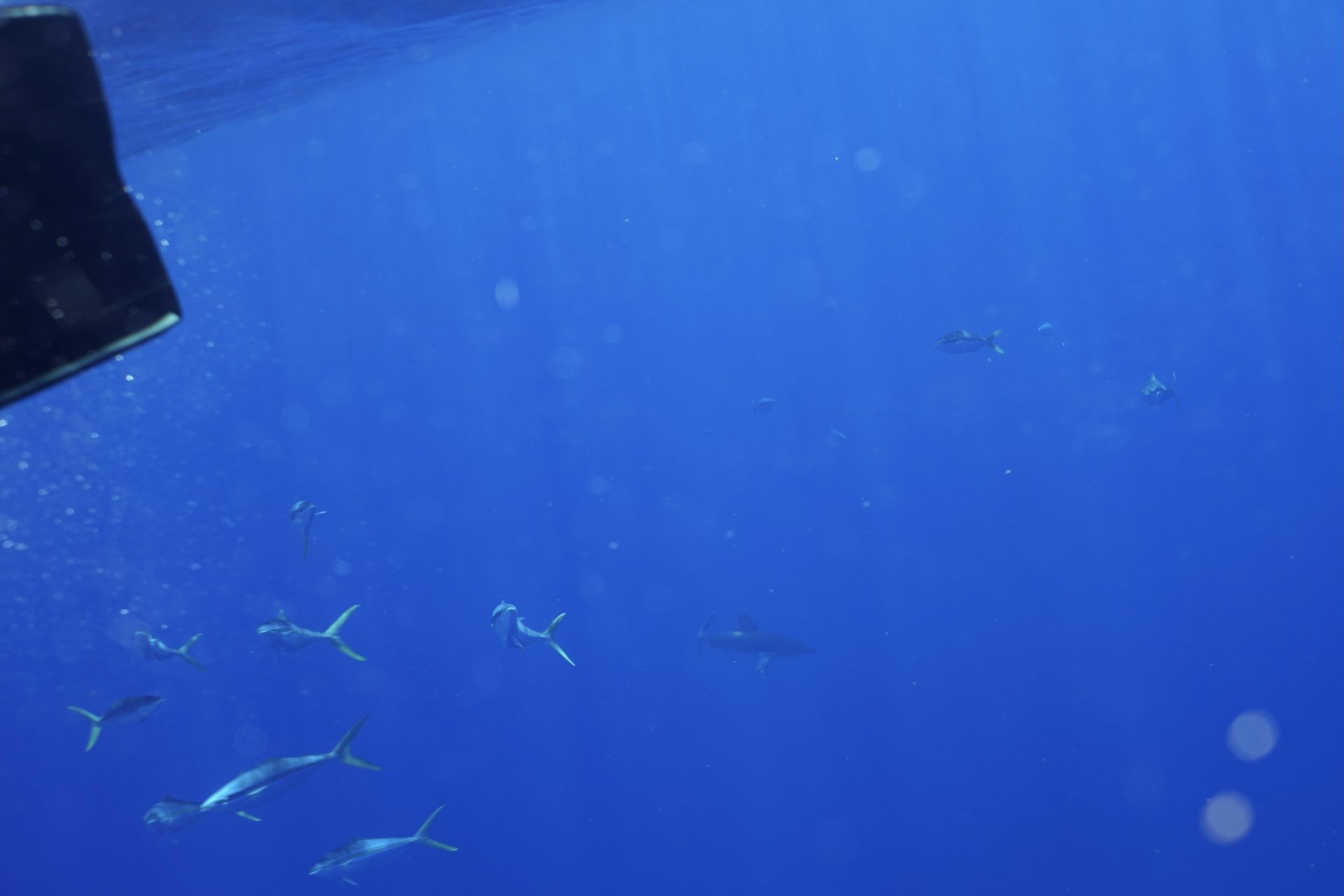
A fish that swims away is not the same as a fish that survives. Anyone who has watched a released red snapper float belly-up 50 feet behind the boat, or seen a sailfish sink tail-first after a long fight in warm water, knows the difference. Release is the default outcome for most of the fish we catch offshore, whether by regulation or by choice, and the point of this article is to make that release count. The tools are simple, the science behind them is fairly settled, and the habits take a season to build.
Barotrauma: what happens on the way up
Reef fish such as snapper, grouper, amberjack and sea bass carry a swim bladder that they inflate to hold depth. When we winch one up from 120 feet, the pressure drops to a fraction of what it was and the gas in that bladder expands several times over. The fish arrives at the surface with its stomach pushed out of its mouth, eyes bulging, belly distended, unable to swim down. That is barotrauma, and left alone the fish drifts on the surface until a shark, a dolphin or a frigatebird ends the story.
The severity depends on depth. Fish caught in 60 feet or less usually recover on their own within a minute. From 60 to 100 feet, symptoms are common and treatment helps. Below 100 feet, nearly every fish shows signs, and below 150 feet, survival without intervention drops sharply. Water temperature and fight time make it worse; a fish hauled up fast through warm summer water suffers more than one brought up steadily in winter.
Venting versus descending
For decades the accepted treatment was venting: inserting a hollow needle through the body wall behind the pectoral fin to release the expanded gas. Done correctly, it works. Done badly, which means the wrong spot, the wrong angle, or puncturing the stomach that is protruding from the mouth rather than the bladder, it kills the fish it was meant to save. Venting also leaves a wound and does nothing for the eyes or the internal organs.
Descending devices changed the picture. A descending device is any tool that carries the fish back to depth and releases it there: a weighted clamp that opens at a preset pressure, a barbless inverted hook on a heavy weight, or a simple weighted crate. The fish is clipped to the device at the surface, lowered on a rod or a hand line to a depth where the pressure recompresses the bladder, usually a third to half of the depth it was caught, and released. Most fish swim off immediately.
Studies of red snapper and rockfish on both coasts have consistently shown that fish returned to depth with a descending device survive at rates that are far higher than fish simply thrown back, with the gap widest for fish caught deep. Several fisheries now require a descending device or venting tool to be aboard and rigged for use whenever reef fish are targeted, and we consider that rule overdue. The device costs less than a decent lure.
Circle hooks and where the hook lands
For pelagic species fished with natural bait, the single largest improvement in release survival came from the circle hook. Its point turns inward toward the shank, so when a fish takes the bait and turns, the hook slides out of the throat and catches in the corner of the jaw instead of the gut or the gills. Research on sailfish, marlin and tuna has repeatedly shown that circle hooks reduce deep-hooking to a small fraction of what J hooks produce, and a jaw-hooked billfish released in good condition has an excellent chance of survival.
The technique differs from J hook fishing and takes some unlearning. There is no hookset. When the fish eats, the angler lets the line come tight, keeps the rod low and simply winds. Trying to strike a circle hook usually pulls it straight out of the mouth. Non-offset circle hooks, where the point is in line with the shank, are the ones that work; the offset versions behave much more like J hooks and are banned in most billfish tournaments for that reason.
Fight time and tackle
A fish fought for 40 minutes on light line arrives exhausted, acidotic and often too tired to recover, however carefully it is handled. Fight time is the variable the angler controls most directly, and the answer is to fish tackle heavy enough to end the fight quickly. A 30 pound sailfish on 20 pound tackle should be boatside in 10 to 15 minutes; a 400 pound blue marlin on 80 pound tackle, with a competent captain backing down, in 20 to 40. Anything much longer risks the fish for the sake of a story about light line.
Handling at the boat
The fewer seconds a fish spends out of the water, the better. For billfish, the standard is that they never leave the water at all: the leader is grabbed, the hook is removed with a long dehooker or the leader is cut close, and the fish is held by the bill alongside the boat for revival. Lifting a large billfish over the gunwale for a photograph damages the internal organs and the protective slime, and in many places it is now illegal for fish that will be released.
For smaller fish that must come aboard, a few practices make the difference:
- Wet hands or a wet rag, never a dry towel, and never a gaff on a fish that will be released.
- A dehooking tool that pushes the hook out without touching the fish, or bolt cutters to cut the hook if it is deep.
- A horizontal hold that supports the belly; hanging a heavy fish vertically by the jaw can separate the vertebrae.
- A rubber-mesh net rather than knotted nylon, which strips slime and splits fins.
- The photograph taken in under ten seconds, with the fish already positioned over the water.
Reviving a tired fish
A fish that cannot hold itself upright needs oxygen moving over its gills. The method is to hold it facing into the current or, more practically, to idle the boat forward at one or two knots with the fish held alongside, bill or lower jaw in hand, so that water flows through the mouth. The color returns first, then the tail begins to kick, then the fish pulls against the hand. That pull is the signal; we let go the moment we feel it. A fish released before it is ready is a fish fed to the first shark in the neighborhood.
None of this is difficult, and all of it is cheap. What it requires is the decision, made at the dock, that the fish’s survival matters as much as the catch. On a good boat that decision is not discussed; it is simply how things are done.