
Bottom fishing does not have the glamour of a marlin release, but ask most saltwater anglers what fills the cooler and the memory, and the answer is grouper and snapper. The reefs, ledges and wrecks of the Gulf of Mexico and the Atlantic coast hold a dozen species worth targeting, and the fishing rewards a careful reading of structure, current and depth. This guide covers the main species, the seasons and closures that change every year, the rigs and line that get fish up, and the descending devices and venting tools that belong in every bottom angler’s kit.
The groupers
Groupers are heavy-bodied, big-mouthed ambush predators that live on or in structure and try to get back into it the moment they are hooked. The red grouper, Epinephelus morio, is the workhorse of the eastern Gulf: a brownish-red fish with pale blotches, common from 5 to 15 pounds, that lives on flat limestone bottom, potholes and low relief in 60 to 250 feet of water rather than high wrecks. The gag, Mycteroperca microlepis, is the grouper of the ledges and wrecks, gray with dark worm-like markings, growing past 30 pounds and prized for its fight; it moves inshore onto shallow reefs in the cooler months and offshore to deeper structure in summer. Scamp, black grouper, yellowedge and snowy grouper round out the catch as depth increases toward 400 to 800 feet.
Groupers are slow-growing and late-maturing, and gags change sex from female to male as they age, which makes the big fish disproportionately important. That biology is why seasons, size limits and closures are strict and shift from year to year as stock assessments change.
The snappers
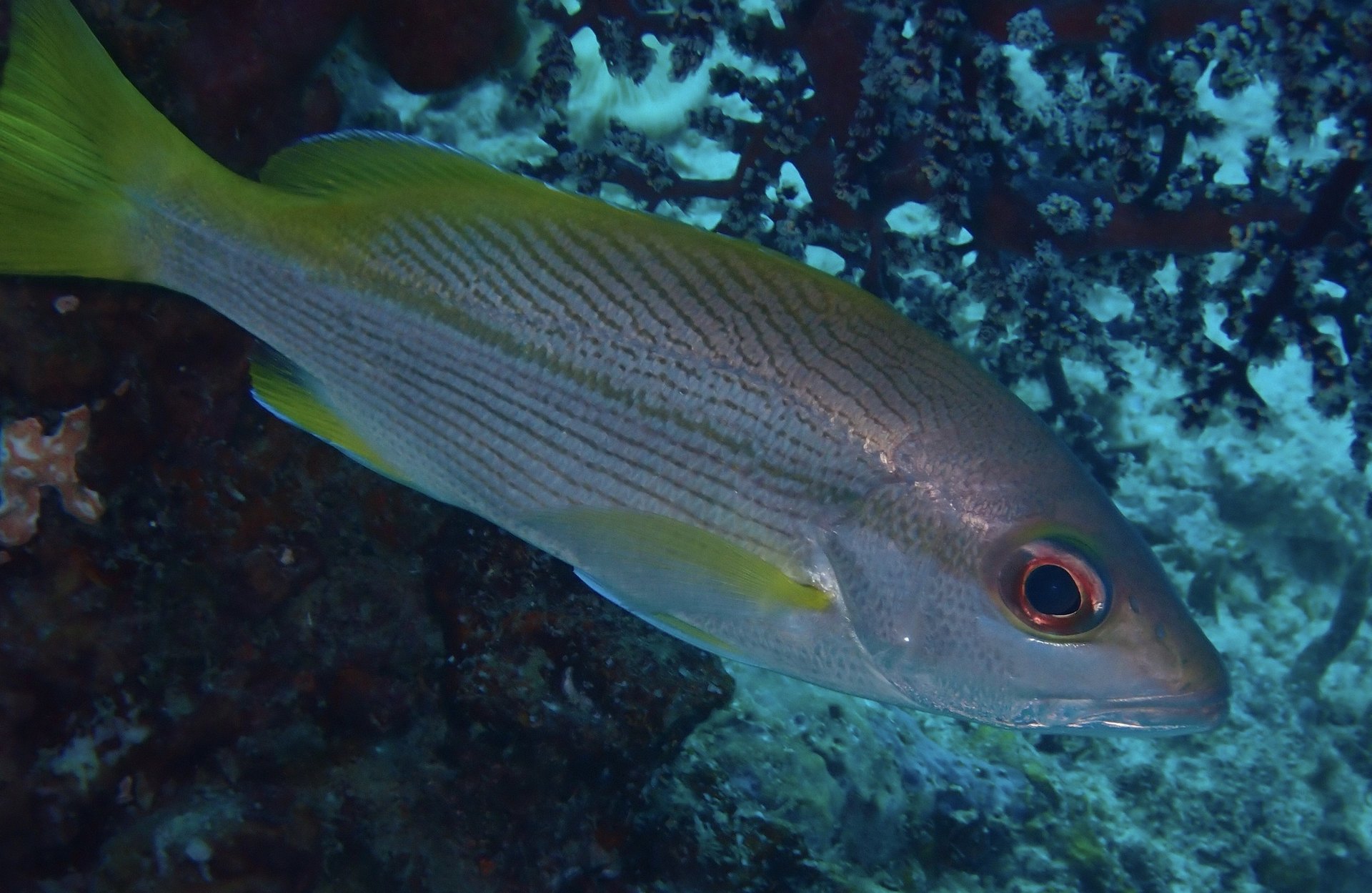
Snappers are more active, more mobile and often more difficult to fool. The red snapper, Lutjanus campechanus, is the most famous and the most regulated fish in the Gulf, a deep-red fish with a pointed anal fin that stacks on wrecks, artificial reefs and natural bottom in 60 to 300 feet. Red snapper can live more than 50 years and reach 40 pounds, though a 10-pound fish is a good one, and the stock’s recovery is a success story of modern management. The mutton snapper, Lutjanus analis, is the trophy of the Keys and South Florida, an olive and rose fish with a black spot on the flank that reaches 20 pounds and feeds around the edges of reefs and sand patches, especially near the spring full moons when it gathers to spawn. The yellowtail snapper, Ocyurus chrysurus, is the light-tackle favorite of the Florida reef, a slim, yellow-striped fish caught in chum slicks in 40 to 120 feet. Mangrove, lane, vermilion and cubera snapper fill out the list.
Reading structure and rigging for the bottom
Bottom fish live on the bottom, but not evenly. The productive spots are edges: the up-current side of a ledge, the corner of a wreck, a hole in a flat limestone plain, the transition from sand to rock. We mark structure on the sounder, note where the bait and the arches stack up, and position the boat so our baits drift down onto the fish with the current, either anchored up-current or held in place with a spot-lock trolling motor.
The rigs are simple. A knocker rig, with an egg sinker sliding directly onto the hook, is the standard for grouper because it gives the angler a direct connection and keeps the bait pinned to the bottom. A three-way or chicken rig with one or two dropper loops above a bank sinker fishes for snapper and mixed bottom. For yellowtail and mutton, the game is a light jig head or a small hook and a tiny weight drifted back in the chum on a long fluorocarbon leader. Baits run from live pinfish and grunts for grouper to cut squid, sardines and bonito strips for snapper. Braided line is the great enabler of modern bottom fishing: 50 to 80 pound braid has almost no stretch, transmits the bite through 200 feet of water and lets the angler turn a grouper away from its hole in the first two seconds. Leaders of 50 to 100 pound fluorocarbon and 5/0 to 8/0 circle hooks, required by rule in much of the Gulf and Atlantic, complete the rig.
- Grouper: knocker rig, 4 to 12 ounce egg sinker, 80 pound leader, live pinfish or grunt
- Snapper: chicken rig with dropper loops, 50 to 60 pound leader, cut squid or sardine
- Yellowtail and mutton: 20 to 30 pound fluorocarbon, small hooks or jig heads in a chum slick
- Line: 50 to 80 pound braid on a conventional reel, heavier for deep-drop species
Descending devices and venting
Fish brought up quickly from more than 50 or 60 feet suffer barotrauma: the swim bladder expands, the stomach pushes out of the mouth and the eyes bulge. Released at the surface, the fish floats and dies. Two tools fix it. A descending device is a weighted clip or a pressure-release hook attached to a spare rod that carries the fish back down to depth, where the gas recompresses and the fish swims free; a venting tool is a hollow needle inserted at an angle behind the pectoral fin to release the gas from the swim bladder before the fish is returned. Descending devices are now required on board when fishing for reef fish in Gulf federal waters and along much of the South Atlantic, and their use is strongly encouraged everywhere. We keep one rigged on a dedicated rod and use it, fast, for every fish we release; it is the difference between a released fish and a dead one.
Seasons, closures and the rulebook
The single most important thing to understand about bottom fishing is that the rules change every year and differ between the Gulf and the Atlantic. In broad terms, Gulf red snapper open for a limited recreational season in federal waters that begins in early summer, with the five Gulf states managing their own seasons in state waters and, under recent arrangements, for their private anglers in federal waters as well. Atlantic red snapper have opened for only a few days a year, if at all. Gag and other shallow-water groupers close for spawning in the Gulf in winter and in the South Atlantic from January through April, with further closures as quotas fill. Mutton and yellowtail snapper have size and bag limits but generally remain open year-round. Amberjack, triggerfish and other reef fish carry their own calendars.
None of that should be treated as current. Before every trip we check NOAA Fisheries, the Gulf or South Atlantic fishery management council, and the state agency for the waters we are fishing, and we carry a current copy of the size and bag limits aboard. Learn the fish, respect the structure, bring the tools to release what you cannot keep, and the reefs will keep feeding you for a lifetime.