
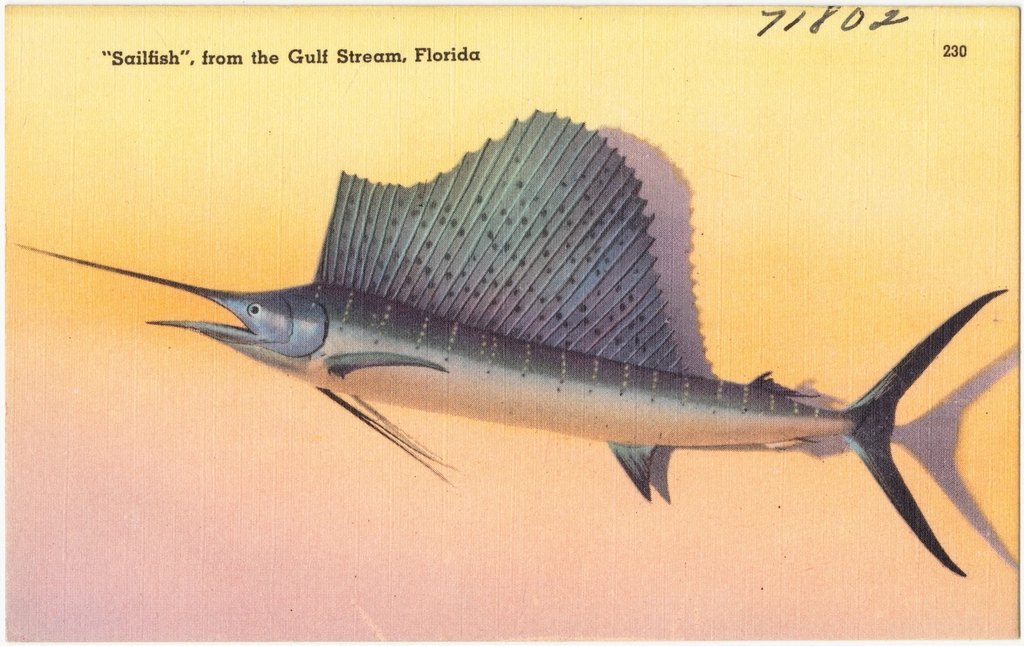
Big-game fishing as we know it, a rod, a reel with a drag, a line with a stated breaking strength and a fish that can tow a boat, is barely older than the automobile. Before the 1890s a marlin or a giant tuna was a commercial catch taken on handlines or harpoons, and no one thought of hooking one for sport. The idea that a person should fight such a fish under self-imposed rules, and be proud of doing so, was invented by a small group of people on a small island off California. Everything since, from the Bimini bluefin to the modern sportfisherman with a tuna tower, descends from that decision.
Catalina Island and the First Rules
In 1898 Charles Frederick Holder, a naturalist and writer, caught a 183-pound bluefin tuna on rod and reel off Santa Catalina Island, and later that year he and a handful of companions founded the Tuna Club of Avalon. What made the club important was not the fish but the rulebook. Members agreed to fish with line of a specified strength, to fight the fish without help, and to record weights honestly. The club awarded buttons for tuna over 100 pounds on 24-thread linen line, and the linen thread count became the first standard tackle class in sportfishing, the direct ancestor of the 30, 50, 80 and 130 lb classes we fish today. Holder also argued, decades ahead of his time, that the point was the contest and not the killing, and the club’s rules penalized fish that were mutilated or taken unfairly. The tackle was primitive: reels without a working drag, so anglers pressed a leather thumb pad against the spool, and rods of hickory or split cane that broke often.
Zane Grey Takes the Idea Around the World
The western novelist Zane Grey (1872-1939) was the first person to fish for big game as a full-time pursuit and to write about it for a mass audience. He fished Catalina, then Nova Scotia for giant bluefin, then Tahiti, New Zealand and Australia, and he spent the fortune his books earned on boats and expeditions. In 1930 off Tahiti he caught a Pacific blue marlin he weighed at 1,040 pounds, the first marlin over 1,000 pounds taken on rod and reel, although sharks had eaten part of it before it was boated. In New Zealand in 1926 he showed the local anglers teaser techniques for striped marlin and mako that they had never seen. Grey’s books, Tales of Fishes and Tales of Tahitian Waters among them, taught a generation that a fish could be the subject of an expedition, and his insistence on recording tackle, line class and fight times fed directly into the record-keeping that came later. He was also a difficult man who quarrelled constantly with the Tuna Club and eventually left it.
Hemingway, Bimini and the Giant Tuna
Ernest Hemingway (1899-1961) fished the Gulf Stream out of Key West and Havana from the late 1920s aboard chartered boats and then, from 1934, his own 38-foot Wheeler, Pilar. In 1935 he went to Bimini in the Bahamas, where giant bluefin passed each spring, and became the first person to land a Bimini bluefin unmutilated by sharks, a 381-pound fish, by fighting it fast and hard before the sharks could find it. The method, heavy tackle and short fights, was new; before it, most Bimini tuna came to the boat as heads. Hemingway also caught a 786-pound mako off Bimini that year and wrote for magazines about marlin behaviour off Cuba with an accuracy that biologists later confirmed. His example, more than his prose, brought money and attention to the Bahamas and the Florida Keys, and the charter fleet that grew there in the 1930s and 1940s was the seed of the modern industry.
The Rybovich Boats and the Sportfisherman
Until the 1940s big-game boats were converted commercial hulls or stock cruisers with a chair bolted to the deck. That changed in West Palm Beach, Florida, where the Rybovich family, John Rybovich Sr. and his sons Johnny, Tommy and Emil, had run a boatyard since 1919. In 1947 they launched Miss Chevy II, a 34-footer designed from the keel up for fishing: a low cockpit close to the water, a flying bridge so the captain could see the fish, outriggers that folded, a transom door and, later, a tuna tower. Johnny Rybovich drew the boats and Tommy built them, and within a decade every serious builder on the East Coast, and then in Australia and the Pacific, was copying the layout. The modern sportfisherman, whatever its size, is still that design: a working cockpit aft, the helm high, the bow flared to run into a head sea, and the whole boat organized around the fighting chair.
The IGFA and the Rulebook
By the late 1930s records were being claimed on every ocean under different rules, and the confusion was obvious. In 1939 Michael Lerner (1891-1978), a New York businessman who had financed scientific fishing expeditions to Nova Scotia, Peru and Australia, founded the International Game Fish Association with the ichthyologist William K. Gregory of the American Museum of Natural History and the writer Van Campen Heilner. The IGFA took the Tuna Club’s idea of standardized line classes and made it worldwide, verified every record claim with line samples and witnesses, and required that the angler fight the fish alone from strike to gaff. The association also published the tackle classes in pounds that replaced the old linen thread counts, and it still administers the records today. Lerner’s own catches, including giant bluefin off Nova Scotia and black marlin off Australia, were secondary to the institution he built.
From the Gaff to the Tag
For its first sixty years big-game fishing ended with a dead fish on a dock scale. That started to change in the 1950s, when the Woods Hole Oceanographic Institution began a cooperative tagging program that asked anglers to release billfish and tuna with a numbered tag instead of killing them, and when the striped marlin fishery off Baja California showed that most fish could be released alive. By the 1980s tournaments in the Bahamas, Florida and Australia were awarding points for released billfish, and the IGFA later added length-based records for fish that were measured and released. The spread of circle hooks in the 1990s, which hook the corner of the jaw rather than the gut, pushed release survival for sailfish and marlin above 90 percent in scientific studies, and in 2008 federal rules made non-offset circle hooks mandatory for billfish in Atlantic tournaments using natural bait. Today the giant bluefin that Hemingway fought is protected by quotas, most marlin and sailfish are released, and the chair and the tower are used to find and photograph fish as much as to kill them. The rulebook that started at Catalina in 1898 is still being written.