
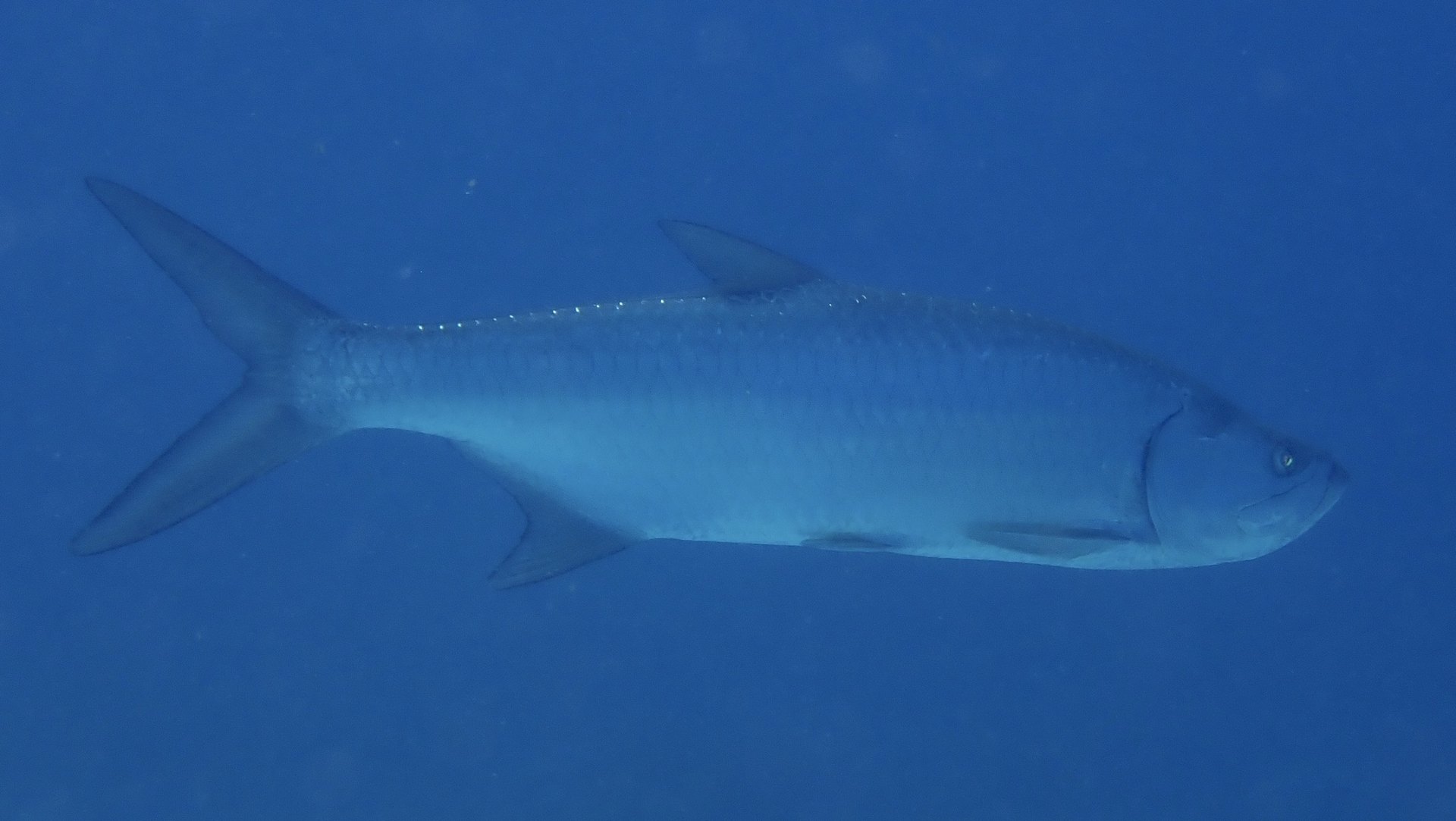
There is a moment, when a tarpon the length of a person launches itself out of the water beside the boat with gill plates rattling, that separates people who fish from people who are hooked for life. Megalops atlanticus is the silver king, the great game fish of the flats, passes and bridges of Florida. This guide covers the biology of a fish that has barely changed in a hundred million years, the spring migration, the baits and tackle that work, and the release ethic that now governs the whole fishery.
An ancient fish
Tarpon belong to a primitive order of fishes and look the part. The body is deep and compressed, plated with huge silver scales the size of a palm, the mouth is upturned and lined with bone rather than teeth, and the last ray of the dorsal fin trails as a long filament. A modified swim bladder lets a tarpon gulp air at the surface, which is why rolling fish are the first sign anglers look for and why the species can live in brackish, oxygen-poor water where other fish cannot.
The species ranges across the western Atlantic from Virginia to Brazil, through the Gulf of Mexico and the Caribbean, and along the coast of West Africa. Adults in Florida typically weigh 60 to 150 pounds, with fish of 100 to 200 pounds the goal of the migration season and the largest fish on record exceeding 280 pounds. Tarpon are slow to mature, reaching breeding age at seven to ten years old, and they live a long time; fish of 50 years have been aged from otoliths. That slow biology is why the species cannot be harvested like a mahi or a wahoo. Spawning takes place offshore in late spring and summer, and the transparent, ribbon-like larvae drift into mangrove backwaters where the juveniles spend their first years.
The spring migration
Tarpon are in Florida in every month, but the fish that make the season are the migrating adults. As water temperatures climb through the mid 70s in late March and April, schools of large tarpon push north along both coasts and gather in the Keys, along the beaches of southwest Florida and in the passes that connect the Gulf to Charlotte Harbor and Tampa Bay. May and June are the peak months almost everywhere in the state. By July many have spread north as far as the Panhandle and the Carolinas. The fall sees a quieter southward drift, and through the winter resident fish settle into deep basins, canals and the backcountry of the Everglades.
Boca Grande Pass, at the mouth of Charlotte Harbor, is the most famous tarpon hole on earth. In May and June thousands of tarpon crowd into a pass barely a mile wide and 70 feet deep, and a fleet of boats drifts over them with live baits and jigs. The Florida Keys offer a different game: fish rolling along the oceanside flats at dawn, staged in the channels and holding in the current under the bridges of the Overseas Highway, where the tide sweeps crabs and baitfish through the pilings.
Live crabs, mullet and the bridges
Tarpon eat almost anything that swims or drifts, but two baits dominate. Live pass crabs, which flush out of the bays on the outgoing tides around the full and new moons, are irresistible in the passes and along the Keys bridges; hooked through the corner of the shell and drifted with the current, a crab rarely lasts long. Live mullet, threadfin herring, pinfish and pilchards are the beach and flats baits, fished under a float or free-lined into a rolling school. Around the bridges we fish live baits and large swimming plugs at night, letting the tide carry them past the shadow line where the fish wait. Fly anglers work the flats with streamers on 11 and 12 weight rods.
Tackle sits in the middle range. Spinning outfits with 6000 to 8000 size reels, 50 to 65 pound braid and 60 to 80 pound fluorocarbon leaders cover the beaches and flats; conventional gear with 80-pound leaders is common in Boca Grande and at the bridges. Circle hooks in the 5/0 to 8/0 range are the rule with natural bait, and in Boca Grande Pass they are required by state regulation.
- Baits: live pass crabs, mullet, threadfin herring, pinfish; plugs and jigs at the bridges
- Tackle: 6000 to 8000 size spinning reel, 50 to 65 pound braid, 60 to 80 pound leader
- Hooks: 5/0 to 8/0 non-offset circle hooks, required by rule in Boca Grande Pass
- Extras: a release tool, a dehooker, bridge net for bait, polarized glasses
Bowing to the jump
A hooked tarpon will jump within seconds, and the first rule of the fight is to bow to the king. As the fish leaves the water, the angler drops the rod tip and pushes it toward the fish, giving slack so the shaking head cannot throw the hook or snap the leader against the taut line. The instant the fish lands, the line comes tight again. The rest is pressure and angles: rod low and to the side, pulling against the direction the fish wants to go. Long fights kill tarpon; the experienced angler lands a 100-pound fish in 20 or 30 minutes by fighting it hard from the start.
Catch and release, by law and by conscience
Florida made the choice years ago. Tarpon are a catch-and-release species in state waters, and the only way to legally harvest one is to buy a tarpon tag in advance, one per person per year, intended for the pursuit of a state or world record. Above a set size a tarpon may not be lifted out of the water, so the picture of a fish across an angler’s lap is now, for most fish, a picture of a violation. The fish stays in the water beside the boat; the angler leans over, the hook is removed or the leader cut, and the fish is held facing the current until it swims off under its own power. Other states and countries have their own rules, so check the state agency and NOAA for the current regulations before you fish.
The science supports the law. Studies of released tarpon show good survival when the fight is short and the fish is kept in the water, and much poorer survival when fish are exhausted, hauled over the gunwale or released near sharks, which have learned to follow the boats in the passes. We move when sharks show up, fish heavy enough to end fights quickly, and take the photograph in the water. A silver king lit up beside the boat is a better trophy than any mount, and letting it go is how there will be one for the next angler.