
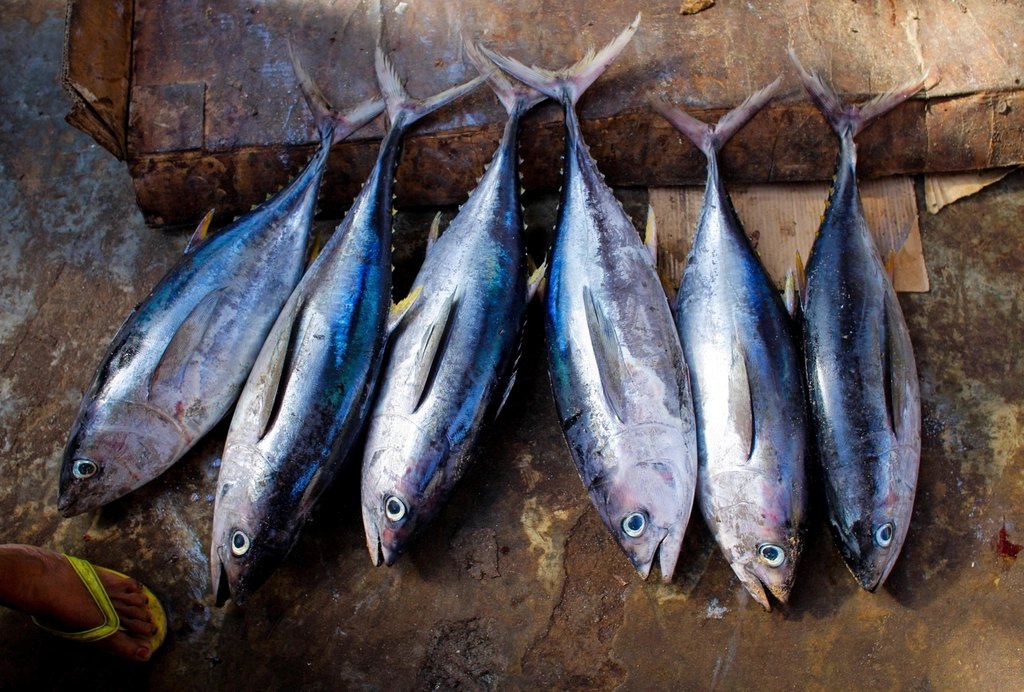
Few fish in the blue water combine size, speed and table quality the way the yellowfin tuna does. Thunnus albacares is a true pelagic wanderer, found in tropical and subtropical seas around the globe, and it has become the backbone of offshore fishing from the Gulf of Mexico to the canyons of the Northeast and the seamounts of the eastern Pacific. This guide brings together what we have learned about where yellowfin travel, what they eat and how to bring one to the gaff.
Identifying the fish and knowing what to expect
A yellowfin is unmistakable once it is on the deck. The body is a deep metallic blue along the back, fading to silver on the flanks with a bright band of gold that gives the species its name. The second dorsal and anal fins are bright yellow, and on older fish they grow into long sickles that can reach halfway back to the tail. The finlets behind them are yellow with black edges. Small yellowfin are sometimes confused with blackfin tuna, which have a shorter pectoral fin and dusky finlets.
Schoolies of 20 to 60 pounds are the common catch on most trips. Fish of 100 pounds are a real accomplishment, and fish over 200 pounds are landed every year in the Gulf, off Cabo San Lucas and in the Revillagigedo Islands. The all-tackle record stands above 400 pounds. Growth is fast: a yellowfin can reach 60 pounds in two years and rarely lives past seven or eight, which is why the stock rebounds quickly when managed with care.
Where they run: temperature, structure and the Gulf rigs
Yellowfin prefer water between 65 and 80 degrees Fahrenheit, with the sweet spot for most fisheries falling between 72 and 78. They hunt along temperature breaks, color changes and current edges where bait stacks up, and they orbit floating structure of every kind. In the northern Gulf of Mexico, the deepwater oil and gas platforms off Venice, Louisiana, are the most famous tuna structure in North America. The rigs act as giant artificial reefs, holding bait from the surface to hundreds of feet down, and the Mississippi River outflow keeps the surrounding water rich year-round.
The Venice fishery has fish in every month, but the best action generally runs from late winter through spring and again in the fall. Summer brings calmer seas and steady numbers of smaller fish; the biggest yellowfin of the year often show up between November and March, when the water cools into the low 70s and the fish feed heavily. Elsewhere, the mid-Atlantic canyons peak from June through September, Southern California and Baja from July into November, and Central American ports such as those on Costa Rica and Panama produce fish through much of the year with spring and summer as the standouts.
What they eat
Yellowfin are opportunists with a preference for whatever is abundant. Flying fish, small squid, sardines, anchovies, threadfin herring and menhaden make up most of the diet in the Gulf, and juvenile blackfin and skipjack are on the menu for bigger fish. In the Pacific they follow sardine and mackerel schools and often travel with spotted dolphins, which is why porpoise pods are a standard sign to look for. The forage tells you how to fish: small bait means a smaller presentation and lighter leader; flying fish mean a popper or a skipping lure.
Chunking, trolling and popping
Chunking is the classic method at the rigs and on the canyon edge. We anchor or drift up-current of structure, cut pogies or bonito into thumb-sized pieces and establish a steady drift line of free chunks. A hook bait is sent back in the slick on an unweighted line, fed out at the same speed as the chunks. Fluorocarbon leaders of 60 to 100 pounds and circle hooks in the 6/0 to 9/0 range are standard; when the fish are leader-shy we go down to 40-pound and accept the occasional break-off. Chunking is at its best at night and in the first hour of daylight.
Trolling covers ground and finds scattered fish. A spread of skirted lures, cedar plugs, feathers and rigged ballyhoo at 6 to 8 knots is the norm, with a bird teaser or a spreader bar on the long rigger to imitate a bait ball.
Popping and jigging have grown into a passion of their own. Heavy spinning outfits with 65 to 100 pound braid, a large popper or stickbait and a leader of 80 to 130 pound fluorocarbon let you cast into a breaking school or a rig up-current. The strike of a 100-pound tuna on a surface plug is why many anglers never go back.
How to fight them
A yellowfin makes one long horizontal run, then sounds and settles into a stubborn circling fight directly under the boat. The angler who wins is the one who keeps steady, unrelenting pressure and never gives back line during the circles. On stand-up gear, a well-fitted harness and a short pumping stroke save your back. On the last 50 feet, be ready for the fish to change direction under the hull; a sharp gaff shot behind the head ends the fight cleanly. Bleed and ice the fish immediately if you plan to eat it, because tuna flesh degrades quickly in warm air.
- Conventional: 50 to 80 pound class outfit, 80 to 130 pound braid, 100 to 150 pound topshot
- Spinning for popping: 8000 to 20000 size reel, 65 to 100 pound braid, 80 to 130 pound leader
- Chunking: 6/0 to 9/0 non-offset circle hooks, 40 to 100 pound fluorocarbon
- Trolling: 7 to 9 inch skirted lures, rigged ballyhoo, cedar plugs, spreader bar
Permits, seasons and the rules of the game
In United States federal waters, yellowfin are managed as a Highly Migratory Species. Any private vessel fishing for tuna, billfish, swordfish or sharks in the Atlantic, Gulf of Mexico or Caribbean needs an Atlantic HMS Angling permit, which is inexpensive and issued annually. Charter and headboat operators carry a separate permit category. Recreational retention of yellowfin has long been limited to a small daily bag per person with a minimum size measured in curved fork length, and reporting requirements exist in some areas. Pacific fisheries follow different federal and state rules, and Mexican and Central American waters each have their own licensing.
These regulations change. Before every trip, we check the current NOAA Fisheries HMS page and the state agency for the port we leave from. The responsible offshore angler keeps only what the crew will actually eat. Handled that way, a yellowfin trip is the hardest and most rewarding day you can spend on blue water.