
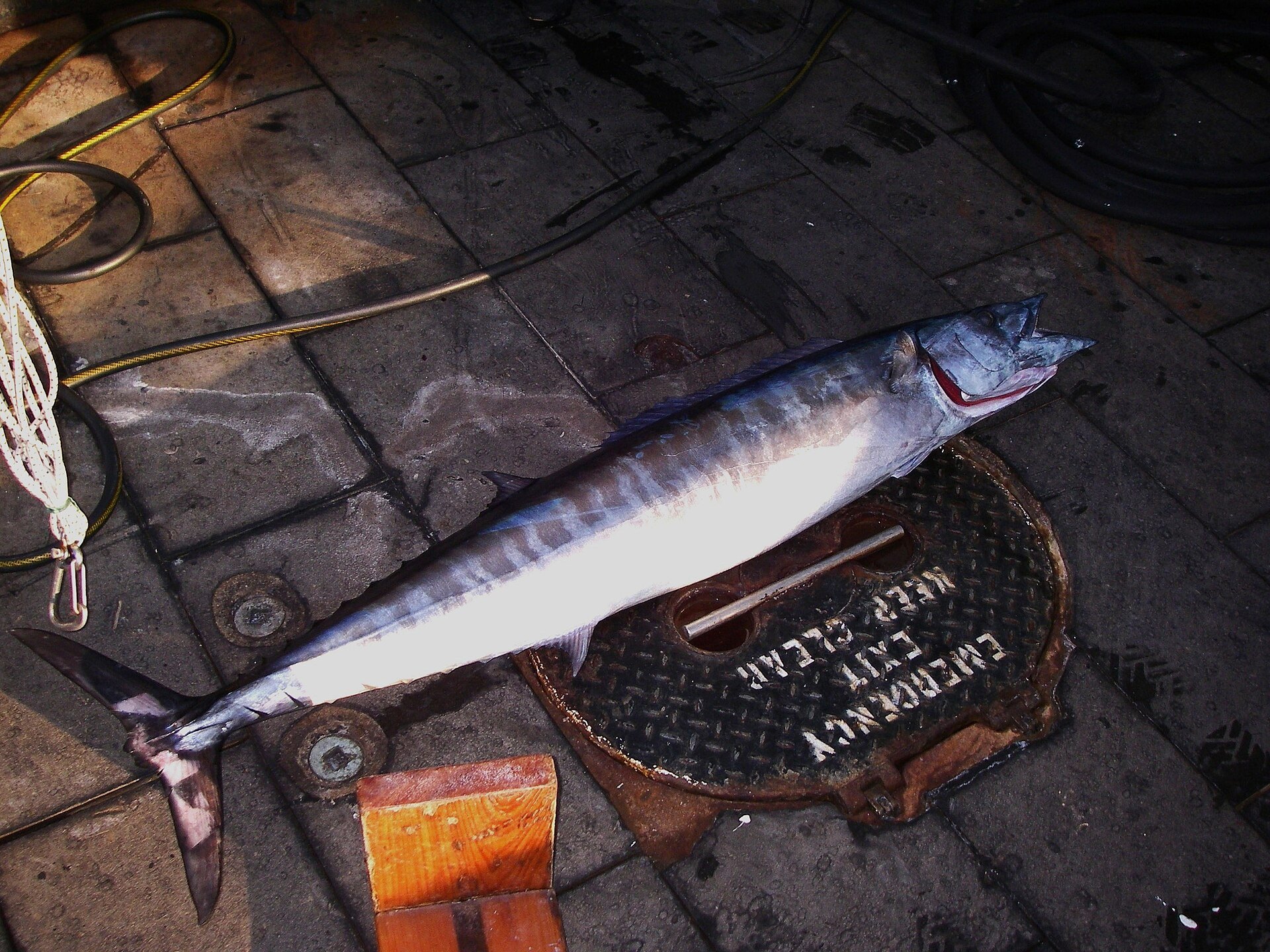
Nothing in the offshore world hits a trolled lure like a wahoo. One second the spread is running quietly at 14 knots and the next a reel is screaming at a pitch you did not know it could make. Acanthocybium solandri is the largest of the mackerels, a solitary sprinter built like a torpedo, with a following of anglers who rig heavy, run fast and bring home some of the best fillets in the sea. This guide covers the fish, the wire that keeps it connected, high-speed trolling, and the seasons from the Bahamas to Bermuda.
A mackerel built for speed
A wahoo is long, slim and iridescent blue-green along the back, with a series of pale blue vertical bars along the silver flanks that blaze when the fish is hooked and fade almost as soon as it hits the deck. The head is pointed, the jaws are long and lined with razor-edged triangular teeth, and a long first dorsal fin folds into a groove along the back. Anglers occasionally confuse a wahoo with a king mackerel; the bars and the longer dorsal settle the question.
Wahoo live in tropical and subtropical waters worldwide and are usually caught alone or in small, loose groups rather than in the tight schools of tuna. Typical fish weigh 15 to 40 pounds, fish over 60 pounds are trophies, and the largest exceed 150 pounds. Growth is rapid and the lifespan is short, generally five or six years, which makes the species resilient under moderate fishing pressure. Speed defines the fish. Bursts of around 60 miles per hour have been claimed, and a wahoo can overtake a lure pulled at 18 knots and cut through it with one bite. They feed on flying fish, squid, small tuna and mackerel.
Where and when to find them
Wahoo hold along steep drop-offs, ledges and the up-current sides of seamounts and banks, and they orbit floating structure the same way mahi do. In the Bahamas, the winter is wahoo season. From November through March, with a peak from December through February, fish stack along the edges of the Northwest Providence Channel, the Tongue of the Ocean, the walls off Bimini and Abaco and the drop-offs of the out islands. The cooler water of the season, in the low to mid 70s, concentrates the fish along the edge where warmer blue water pushes in.
Bermuda’s season runs the other way. Wahoo appear in numbers on the banks and along the island’s edge from May into October, with the strongest fishing in late spring and again in early fall when the water cools out of its summer peak. Elsewhere, the Florida Keys see fish through the winter and around the summer full moons, the northern Gulf of Mexico fishes best from late fall to early spring along the deep rigs, and Hawaii, where the fish is called ono, produces wahoo most of the year with a summer peak. Wahoo prefer water from about 70 to 86 degrees and are often caught deeper than the surface temperature suggests.
High-speed trolling
The wahoo fleet learned long ago that speed is not a problem but a tool. Trolling at 12 to 18 knots, far above the 6 to 8 knots used for mahi and tuna, lets a boat cover miles of drop-off in a morning, triggers reaction strikes from fish that ignore slow baits and keeps most other species off the hook. The lures are heavy, bullet-shaped heads of lead or steel weighing 8 to 32 ounces, dressed with a skirt or a jet head, run on a short spread with the lines close to the boat. Trolling weights of 16 to 48 ounces or in-line planers pull the lures down 20 to 40 feet where the fish hunt. Darker colors such as black and purple, black and red and blue and silver are standard in the low light of dawn and dusk, when the bite is usually best.
At slower speeds, wahoo also take skirted ballyhoo, swimming plugs and live baits on a downrigger. Tackle for the high-speed game is heavy: 50 to 80 pound class conventional outfits, 80 to 130 pound braid or monofilament and drags set firm.
- Speed: 12 to 18 knots with heavy bullet lures; 6 to 9 knots with ballyhoo and plugs
- Line: 50 to 80 pound class outfits, 80 to 130 pound braid or mono
- Leader: 6 to 12 feet of single-strand wire, number 9 to 12, or 275 to 400 pound cable
- Depth: trolling leads of 16 to 48 ounces or planers to get lures 20 to 40 feet down
Wire leaders and the teeth
Monofilament and fluorocarbon leaders do not survive wahoo teeth. Every rig in a wahoo spread ends in wire: single-strand stainless in sizes 9 to 12 for lures and ballyhoo, or multi-strand cable rated 275 to 400 pounds for the heaviest high-speed heads. Single-strand wire is joined with a haywire twist and a barrel wrap, and the ends are broken off cleanly rather than cut so no tag is left to slice a hand. Many crews run a short section of wire at the hook and a monofilament shock leader above it, which gives the mate something safe to grab. Check the wire after every fish; a kink is a break waiting to happen.
Those same teeth demand respect on the deck. A wahoo is not dead when it stops thrashing, and its jaws can close on a finger or a calf without warning. We gaff the fish in the head, swing it into a fish box or onto the deck away from feet, and dispatch it immediately with a bat or a knife at the base of the skull. The hook comes out with long pliers, never fingers, and the fish goes into the box before anyone reaches for a camera.
Regulations and the table
Wahoo are managed in United States Atlantic and Gulf waters with a per-person daily bag limit, and Florida and other states set their own limits in state waters; Bahamian and Bermudian rules apply in their own waters and generally require a fishing permit. These numbers change, so we check NOAA Fisheries and the state or national agency before each trip. Wahoo are considered a healthy stock, but the fish that reach 60 pounds are the females that sustain it, and one big fish feeds a lot of people.
On the plate, wahoo is exceptional. The flesh is white, firm and mild, with very little of the oiliness of other mackerels, and it holds together beautifully when grilled, seared or cut into thick steaks. Bleed the fish at once and ice it hard; the meat dries out if overcooked, so we pull it from the heat while the center is still barely translucent. Among people who fish offshore for the table, wahoo sits at the very top.